This piece is part of my travel journal. It is written from my own experience, understanding and feelings about the culture I encountered. I am no historian or archaeologist, just someone who became unexpectedly fascinated by what I saw and experienced.
Not every time I travel do I have the urge to sit down and write a journal. But this trip was special. Maybe it is simply the feeling that I want to remember it that brought me here.
Originally, Crete was supposed to be a beach, sea, sand and sun holiday, but it turned out to be much more historically educational than I expected. And I'm glad it did.
Crete is historically important for many reasons, but what caught my attention most was the Minoans. Seb, my husband, and I ended up exploring their history together, first at Knossos Palace and later at the Heraklion Archaeological Museum.
We both agreed on how fascinating it was.
There is something about seeing an object behind museum glass and realising that the person who made it lived thousands of years before you. Not a photograph of the object. Not a reproduction. The actual thing that someone's hands once touched.
Throughout this trip, one thought kept coming back to me:
It amazes me how much humans have always been capable of.
People Were Creating Long Before Us
We live in a world where technology assists almost everything we do.
We have machines, computers, the internet, AI. We can search for information within seconds. We have tools that make creation easier, faster and more precise.
But here, you stand in front of something made thousands of years ago and realise that humans were already designing, experimenting, building, trading, decorating and creating.
They weren't simply trying to survive.
They were creating a complex world around them.
FIRST STOP: THE KNOSSOS PALACE
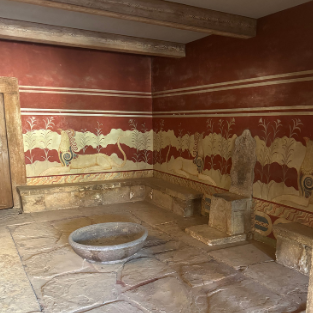
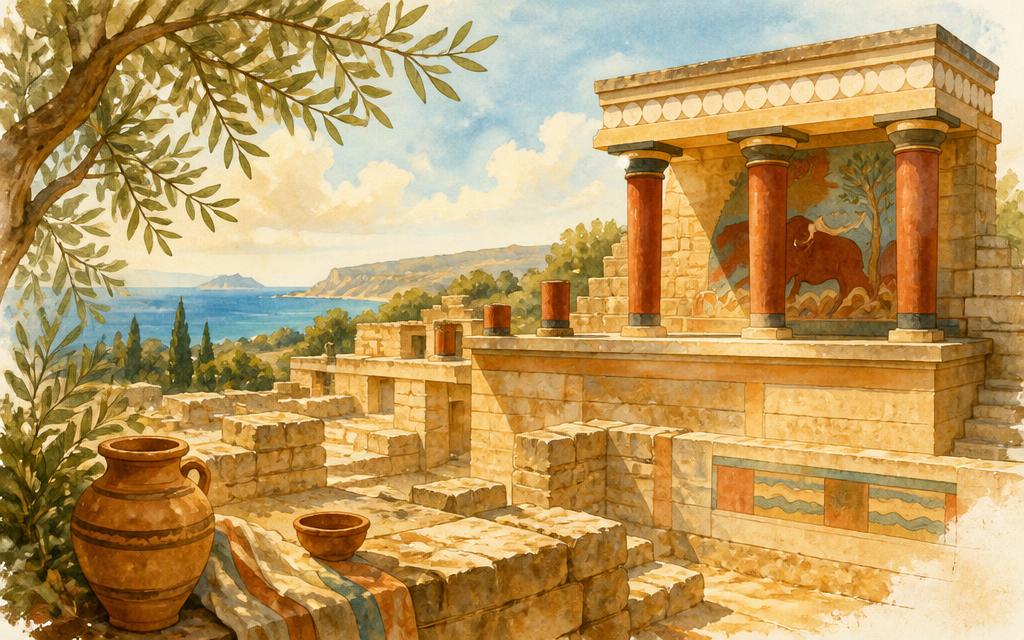
The civilisation we now call Minoan flourished on Crete during the Bronze Age (3300-1200 BC). At Knossos, the first palace was built around 2000 BC. It was destroyed and rebuilt, and the enormous complex developed over centuries into a centre containing storerooms, workshops, shrines, halls and the famous throne room.
One of the moments at Knossos that impressed me most was the throne room.
Inside is a stone throne. A piece of history from 3,500 years ago. And it's one of the oldest surviving stone thrones in Europe.
I think that was the part that put me in awe. This wasn't simply something made to show modern visitors what a throne might have looked like. I was standing in front of an ancient stone seat inside the actual palace.
But what surprised me was how ordinary the throne looked.
It was tiny.
Much smaller than the image that comes into my head when I hear the word throne. It made me wonder about the person who might have sat there and how different people themselves might have been from us.
And it was so mundane compared with the extravagant thrones we associate with kings and queens in later history. No enormous golden chair towering over everyone.
I couldn't help imagining it.
Thousands of years ago, another human being might have occupied this very seat.
And once I thought about that, the throne became much more than an old object to me.
A special seat inside a room like this suggests something about the complexity of the society that created it: authority, status, ceremony or ritual. Archaeologists still debate exactly who used the throne and what happened in this room, so I don't want to imagine that we know more than we actually do.
I think sometimes when we imagine people living thousands of years ago, we unconsciously imagine a simpler version of ourselves.
Standing in that room made that idea feel wrong to me.
Their technology was different.
Their world was different.
But humans were already complicated.
How Much Can We Really Know?
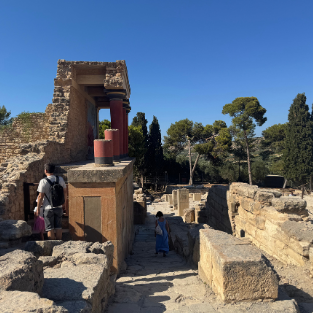
How much can we really know about people who lived thousands of years ago?
This question is particularly interesting at Knossos because parts of what visitors see were reconstructed under the archaeologist Arthur Evans.
Some of his reconstructions and interpretations have been questioned since.
I find this uncertainty fascinating.
We have foundations.
Fragments.
Frescoes.
Pottery.
Figurines.
Architecture.
Writing (some of which we still cannot read)
But we don't have the people who can explain any of it to us.
So we try to reconstruct their world from what remains.
Maybe because I spend so much time thinking about stories, I noticed something familiar in that process.
When we read a story, we are given words and fragments, and our mind builds the world around them.
Archaeology is obviously not fiction. It depends on physical evidence, comparison and careful research. But as an ordinary visitor looking at these remains, I could feel my own mind constantly wanting to fill in the gaps.
Who sat here?
What did this room mean to them?
What did they believe?
We have their objects.
But we don't have their answers. Perhaps some things will always be left to our imagination.
NEXT STOP: THE HERAKLION ARCHAEOLOGICAL MUSEUM
After we were done with our visit to Knossos Palace, our next destination was the Heraklion Archaeological Museum.
If Knossos showed me the scale of this ancient society, the museum made me think about the individual people inside it.
The museum is not only about the Minoans. Its collections stretch across a much longer period of Cretan history, beginning long before the Minoan palaces and continuing long after them.
I actually think that makes the experience more interesting.
You start to see that civilisation isn't simply there.
It develops.
People learn things. Someone discovers a different way to make something. Techniques pass from one person to another. Trade introduces new materials and influences. Artistic styles and beliefs change.
Generation after generation, humans build on what came before them.
My advice if you visit the museum is very simple:
Slow down.
Don't go there trying to take a photo of everything.
I know the temptation. There are so many objects that eventually everything can become another old pot, another figurine, another display case.
Instead, pick a couple of things in each room. Look at them properly. Read about them. Understand what you are actually seeing.
Prepare yourself a little before going. Check a few of the museum highlights, but also allow yourself to discover things you weren't looking for.
Because some of the objects that stayed with me most weren't necessarily the famous ones I went there expecting to see.
A Woman From Thousands of Years Ago
One of the first objects that stopped me was incredibly simple.
A small clay figurine of a squatting woman from Neolithic Crete, dating from thousands of years before the great Minoan palaces.
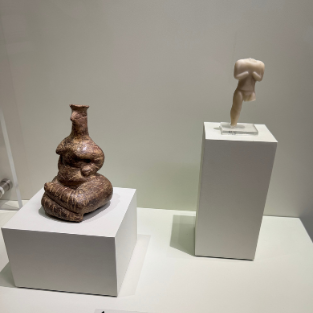
She is incredibly old. According to the museum label, she could be up to 7,300 years old.
I think sometimes numbers become too large for us to properly feel them. You read several thousand years on a museum label and move on.
But stop for a moment and think about it.
Someone made this.
A person took clay in their hands and shaped the human body.
I don't know who that person was. I don't know exactly why they made her. I don't know what the figurine meant to them.
But I can see the result of their hands.
That is what impressed me.
We often look at ancient craftsmanship through modern eyes and focus on what people didn't have.
No modern machines. No electricity. No computer-assisted design. None of the tools that make production faster and easier for us today.
And yet they created.
Looking at this little woman, I started to feel that perhaps ancient people deserve much more credit than we normally give them.
The Bull-Leaper
Another object that really impressed me was the ivory bull-leaper from Knossos, dating to around 1600-1500 BC.
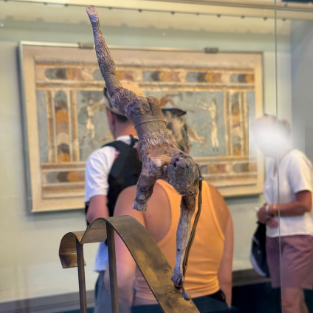
There is something beautiful about the human body in it.
The male figure is captured in the middle of an acrobatic movement. The museum describes it as part of the only three-dimensional representation of bull-leaping from the Palace of Knossos known so far.
Look closely and there are even details such as muscles and fingernails.
Just imagine how much detail and effort went into creating this!
And unlike an object that could have come from almost anywhere, this one immediately made me think of the particular visual culture of Minoan Crete. Bulls appear repeatedly in the imagery connected with Knossos.
We don't know everything about what bull-leaping meant or precisely how it was practised.
But what interested me was that someone chose to represent the human body this way.
Not simply standing.
Moving.
Performing.
Almost flying.
There is an aesthetic idea there.
Humans weren't only making useful things. They were interested in how the body looked, how movement could be represented and how an idea could become an object.
Art exists alongside humans.
I think it always has.
Imagining What We Cannot Know
The Hagia Triada Sarcophagus affected me for a different reason.
It dates to around 1370-1320 BC and is covered with scenes of funerary ritual: offerings, libations, music, a bull sacrifice and the deceased receiving offerings.
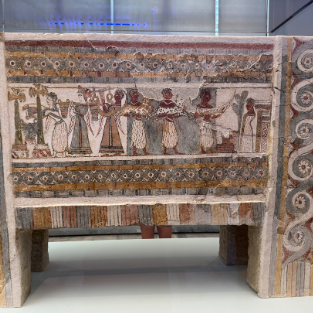
Here I wasn't thinking so much about technical skill.
I was thinking about imagination.
More specifically: human imagination in front of the unknown.
Death might be the greatest unknown humans have ever had to face.
We know that life ends.
But what happens after it?
People thousands of years ago couldn't know for certain.
Neither can we.
And yet across cultures and across history, humans have imagined answers.
We create gods. Afterlives. Rituals. Offerings. Ceremonies. Stories about where a person goes when their body is no longer alive.
Standing in front of the sarcophagus, I wasn't only looking at an ancient funerary object.
I was looking at evidence of people trying to understand something humans still cannot completely understand today.
Their answers might be different from ours.
The question isn't.
And Then, a Much Later Crete
There was another object I found myself thinking about: a circular shrine model with a female figure inside and two male figures looking through an opening in the roof.
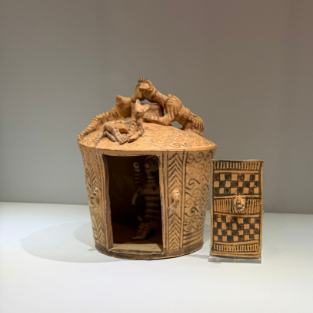
This one is important to separate from the Minoans.
It comes from much later Cretan history, around the late 9th century BC. The female figure inside is a goddess of the type known as a Goddess with Upraised Arms, while the figures looking through the roof have been interpreted as possible worshippers.
According to the museum label, the scene probably reflects beliefs about contact between the terrestrial world and the underworld, and ways of evoking the goddess who protected the deceased.
The figures seem to be trying to look in, to see or reach something beyond their own world.
It made me think about human curiosity, especially our curiosity about things we cannot see or fully understand.
What happens after death? Is there another world beyond ours? Can we somehow communicate with it? These are not only ancient questions. Thousands of years later, we are still curious about the unknown. We still imagine what might exist beyond what we can see, and we still search for ways to understand things that may never have a definite answer. And there was something almost strange about standing in the museum looking at this little scene.
The figures are looking in, trying to reach their goddess. And thousands of years later, I was looking in too. Trying to understand them. Maybe the beliefs have changed. Maybe the questions have changed. But the curiosity remains. Curiosity belongs to humans.
We Have Always Needed Meaning
The more I looked at the objects in the museum, the less interested I became in seeing them simply as ancient things.
They are evidence of minds.
A throne makes me think about organisation and authority.
An acrobat captures movement and beauty.
A shrine model gives physical form to human beliefs about the world beyond our own.
A sarcophagus shows people responding to death through ritual.
The jewellery shows that beauty mattered.
The elaborate pottery tells us that a container didn't always need to be only a container.
Trade brought people and materials into contact across the Mediterranean.
And the architecture tells us that someone had to imagine a structure before other people could build it.
Again and again I came back to the same thought.
Humans create.
Maybe creativity is much more fundamental to being human than I had thought before this trip.
Perhaps We Are Cleverer Than We Give Ourselves Credit For
I don't mean that ancient humans were somehow more talented because they didn't have modern technology.
And I don't think technology makes our achievements less impressive either.
What changed for me was the way I thought about human ability itself.
Technology is something humans created too.
Every generation starts with something left by the generation before it. We learn, change it, improve it, sometimes make mistakes, and pass something else forward.
Our individual lifespan is limited.
Human learning isn't limited in the same way.
One person doesn't need to discover everything again from the beginning.
Knowledge continues.
Maybe that is one of the most extraordinary things about us.
We might be cleverer than we give ourselves credit for.
But We Should Be Careful With the Stories We Tell
There is also something I realised while learning about the Minoans.
We naturally want to turn fragments into a complete story.
I was initially attracted to the idea of the Minoans as a peaceful society focused on art, trade and culture rather than kings and warfare.
It's a beautiful picture.
Maybe too beautiful.
The evidence doesn't allow us to say confidently that Minoan society had no warfare or no powerful rulers. Even the word palace can encourage us to imagine a political system that may not have worked exactly as we picture it.
What survives doesn't show us everything about a civilisation.
There are things archaeologists know from evidence.
There are things they can reasonably interpret.
And there are things we may simply never know.
Our minds don't particularly like that last category.
We want the Snake Goddesses to have one clear identity, although they have been interpreted as goddesses or priestesses.
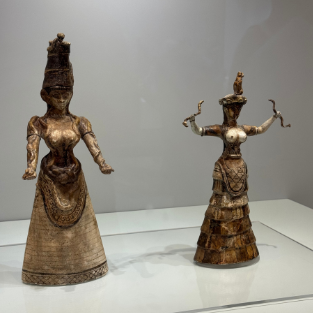
We want to know exactly what bull-leaping meant.
We want the Phaistos Disc translated.
We want to look at Knossos and say:
Yes. That's how it was.
We want the fragments to become a story.
Maybe that is something very human too, the need to make sense of what we don't fully understand.
WHAT I BROUGHT HOME FROM CRETE
I came to Crete expecting a relaxing beach holiday.
I did get the sea, sand and sun.
But somehow I came home with more respect for the people who lived before us.
Time is one of the limitations of an individual human life.
We are here for only a short period.
But humans have never stopped developing and learning.
Generation after generation, we make things.
We observe.
We experiment.
We imagine.
We believe.
We question.
We tell stories.
We leave something behind.
And another generation continues from there.
Maybe this is why I felt the urge to write about Crete when I don't write about every place I visit.
I wanted to remember the palace and the museum, of course.
But more than that, I wanted to remember the feeling they gave me:
that human beings have been curious, complicated and creative for a very, very long time.