
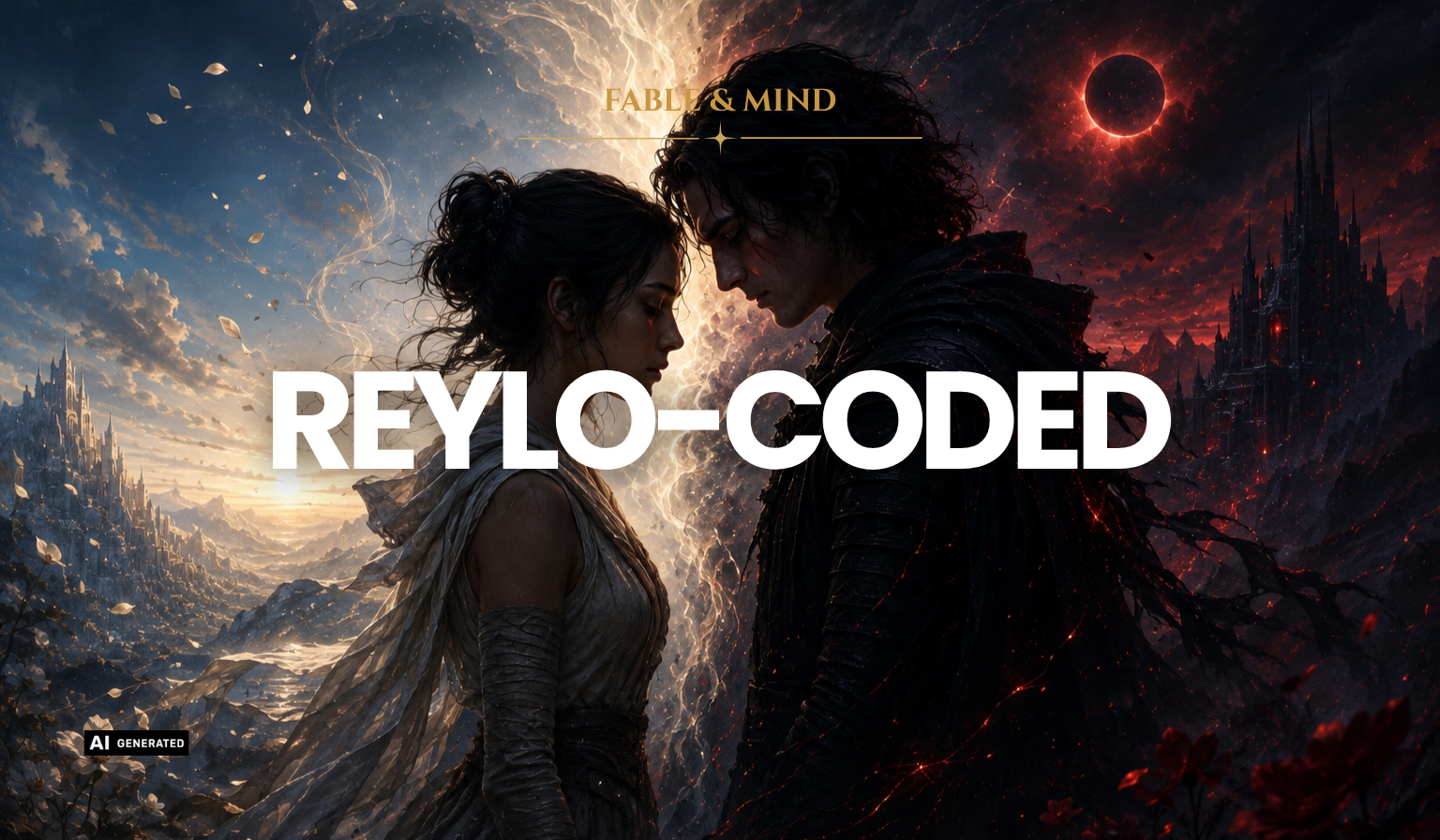
You want the enemies who understand each other better than anyone else does. The bond that neither of them asked for. The villain who is not beyond saving, and the heroine who refuses to look away from him.
That specific dynamic has a name in fandom shorthand: Reylo, after Rey and Kylo Ren. And even readers who never watched a single Star Wars film use it now, because it describes something books do beautifully.
This guide breaks down what makes a book Reylo-coded, why the trope is psychologically addictive, and which romance and romantasy novels deliver it best.
What Does "Reylo-Coded" Actually Mean?
Reylo-coded is not simply enemies to lovers. Plenty of books have two characters who bicker and then kiss. That is not the same thing.
A Reylo-coded romance usually has most of these ingredients:
- •A tethered bond. A psychic link, a soul bond, a mating bond, a magical connection neither character chose. They can feel each other. They cannot escape each other.
- •Opposing sides. She belongs to the light, the rebellion, the mortals, the good side. He belongs to the empire, the court, the dark. The conflict is structural, not a misunderstanding.
- •Power imbalance that shifts. He starts with the power. She refuses to be afraid of him. Somewhere in the middle, the balance flips.
- •A redemption arc that costs something. He does not simply apologise. He loses something to change.
- •Emotional intimacy before physical intimacy. They know each other's worst memories before they touch.
- •"You're not alone." "Neither are you." Two profoundly lonely people recognising each other.
That last one is the heart of it. Reylo is a loneliness story wearing an enemies-to-lovers costume.
Reylo-coded romance is not about the fight. It's about being seen by the one person who should have been your enemy.
The Psychology of Why Reylo-Coded Romance Works
There are a few reasons this dynamic grips readers far harder than a standard love story.
1. Being fully known is the real fantasy
Most romantic fantasies are about being chosen. Reylo-coded romance is about being known, including the parts you hide. The bond makes concealment impossible. He sees her fear and her rage; she sees his shame. Nobody performs.
For readers who spend real life managing how they are perceived, that can feel like an enormous release. There is something psychologically potent about being known without having to perform: research on self-disclosure has long associated it with intimacy and closeness.
2. The shadow self, again
Through a Jungian lens, Kylo-type characters can represent the "shadow". Qualities we reject, suppress, or would rather not recognise in ourselves: anger, ambition, envy, even the capacity for cruelty.
3. Redemption is a story about hope
A redemption arc quietly argues that a person is not permanently defined by their worst act. That belief can be comforting far beyond fiction, and helps explain why readers become so fiercely invested in characters who still seem capable of change.
4. Tension is the engine
A bond that forces proximity while the plot forces opposition creates near-constant tension. Every scene has stakes. Research on romantic attraction has even found that uncertainty can intensify attraction, partly because uncertainty can make us think about the other person more.
Reylo-Coded Books: The Reading List
The Cruel Prince — Holly Black
The blueprint for a generation of romantasy readers. Jude and Cardan (Read a full Cardan Greenbriar character analysis) are enemies with genuine cause to hate each other, and the cruelty is real rather than decorative. What makes it Reylo-coded is the mutual recognition underneath it. Two people performing power because they are terrified of being powerless. Cardan's arc across the trilogy is one of the most satisfying redemption arcs in modern fantasy.
Best for readers who want the hate to feel earned before the love does.
Alchemised — SenLinYu
If you want one of the darkest books on this list, Alchemised gets remarkably close to the emotional architecture Reylo readers tend to love. Although its actual fandom roots are Dramione, not Reylo. SenLinYu reimagined their hugely popular Harry Potter fanfiction Manacled into an original fantasy world, while retaining its interest in war, captivity, memory, moral ambiguity and impossible attachment.
Best for readers who want the dark, morally serious end of the spectrum.
A Court of Mist and Fury — Sarah J. Maas
The mating bond, the villain who was never the villain, the man who let himself be hated to protect someone. Rhysand's reveal is a masterclass in reframing a character, and the bond gives that unchosen, inescapable tether Reylo readers are chasing.
Best for readers who want the comfort and the payoff, not only the pain.
The Love Hypothesis — Ali Hazelwood
I'm stepping outside my usual fantasy and romantasy recommendations for this one, because The Love Hypothesis deserves a place on this list for one very specific reason: it doesn't just feel Reylo-coded, it has Reylo in its DNA.
The novel grew out of Ali Hazelwood's fanfiction writing, with the story that eventually became The Love Hypothesis inspired by Rey and Kylo Ren. The setting may have shifted from a galaxy far, far away to the world of academia, but the emotional blueprint is unmistakably familiar: an intimidating, misunderstood man; a bright, stubborn heroine; forced proximity; simmering tension; and the gradual realization that his feelings are very different from what she assumed.
So while contemporary romance isn't normally where I wander when looking for my next fantasy obsession, I couldn't make a guide to Reylo-coded romance and leave out one of the clearest examples of Reylo's DNA making its way into traditionally published fiction.
Best for readers who want to see Reylo's influence reach contemporary romance.
One Dark Window — Rachel Gillig
A gothic bargain, a monster living inside her head, and a relationship built entirely on being inside each other's thoughts. The intimacy here is psychological before it is anything else, which is exactly the Reylo appeal.
Best for readers who love atmosphere and a bond that is literally in the mind.
Six of Crows — Leigh Bardugo
Not enemies in the traditional sense, but Kaz and Inej deliver the other half of the Reylo formula: two damaged people who see each other with total clarity and refuse to lie about it. The restraint is the romance.
Best for readers who want longing over declarations.
Fourth Wing — Rebecca Yarros
Opposing loyalties, a lethal power imbalance, and a hero whose secret makes every earlier cruelty legible in hindsight. Violet and Xaden hit the "he was protecting her the whole time" note squarely.
Best for readers who want the trope with high pace and high stakes.
Blood Over Bright Haven — M.L. Wang
The quieter pick, and a different flavour: the moral greyness sits in the institution rather than one love interest. If what you actually love about Reylo is the question of complicity and redemption, this one will wreck you.
Best for readers who want the moral weight without the fated-mates packaging.
What Are the Differences Between Enemies-to-Lovers and Reylo-Coded?
The biggest difference is that enemies-to-lovers is a trope, while Reylo-coded describes a specific type of relationship dynamic inspired by Rey and Kylo Ren.
Here's a simple comparison:
| Enemies-to-Lovers | Reylo-Coded |
|---|---|
| Characters begin as enemies or rivals and eventually fall in love. | Characters evoke the emotional dynamic of Rey and Kylo Ren, whether or not they start as enemies. |
| Focuses on the plot progression (enemy → lover). | Focuses on the relationship's emotional and psychological feel. |
| Can be lighthearted, comedic, or low-stakes. | Usually features intense emotional tension, moral conflict, obsession, vulnerability, and powerful chemistry. |
| Doesn't require redemption or internal conflict. | Often includes a morally gray or damaged hero, a compassionate heroine, redemption arcs, and themes of darkness versus light. |
Many Reylo-coded books are enemies-to-lovers, but not all enemies-to-lovers books feel Reylo-coded.
How to Spot a Reylo-Coded Book Before You Buy It
When you are scanning a blurb, look for these signals:
- •A bond, link, tether, or mark neither character consented to
- •Two characters described as being on opposite sides of a war, court, or throne
- •A love interest introduced as a threat rather than a prospect
- •Language about being "the only one who understands" the other
- •A hero with a body count and a reason for it
If three or more of those appear, you are probably in the right place.
A Note on Why We Keep Coming Back
The Reylo dynamic endures because it takes the loneliest question a person can ask: Would you still want me if you saw all of it? And answers yes, from the one character who has every reason to say no.
That is not really about villains. It is about forgiveness, and about the hope that the worst thing we have ever done is not the whole story.
Read slowly, think deeply, and meet your favourite books on a different plane.
If you want recommendations beyond this trope, browse my 20 best fiction books to read across fantasy, sci-fi, and literary fiction.
Sources & Further Reading
• American Psychological Association, "Self-Disclosure". Background on self-disclosure, intimacy and interpersonal relationships.
• Zweig, Connie. "Shadow-Boxing. An exploration of the Jungian shadow, projection, and how disowned aspects of ourselves can emerge within romantic relationships.
• Whitchurch, Wilson & Gilbert. "He Loves Me, He Loves Me Not. Research on uncertainty and attraction.
• SenLinYu interview. Discussion of Manacled, Alchemised, fanfiction and transforming the story into an original novel.
• Ali Hazelwood interviews/profile. Background on The Love Hypothesis and its fanfiction/Reylo origins.
Write It Down
If one of these books leaves you staring at the ceiling at 2am, that reaction is worth recording. The Thinking Reader Journal is built for exactly that — a place to work out why a story got under your skin.